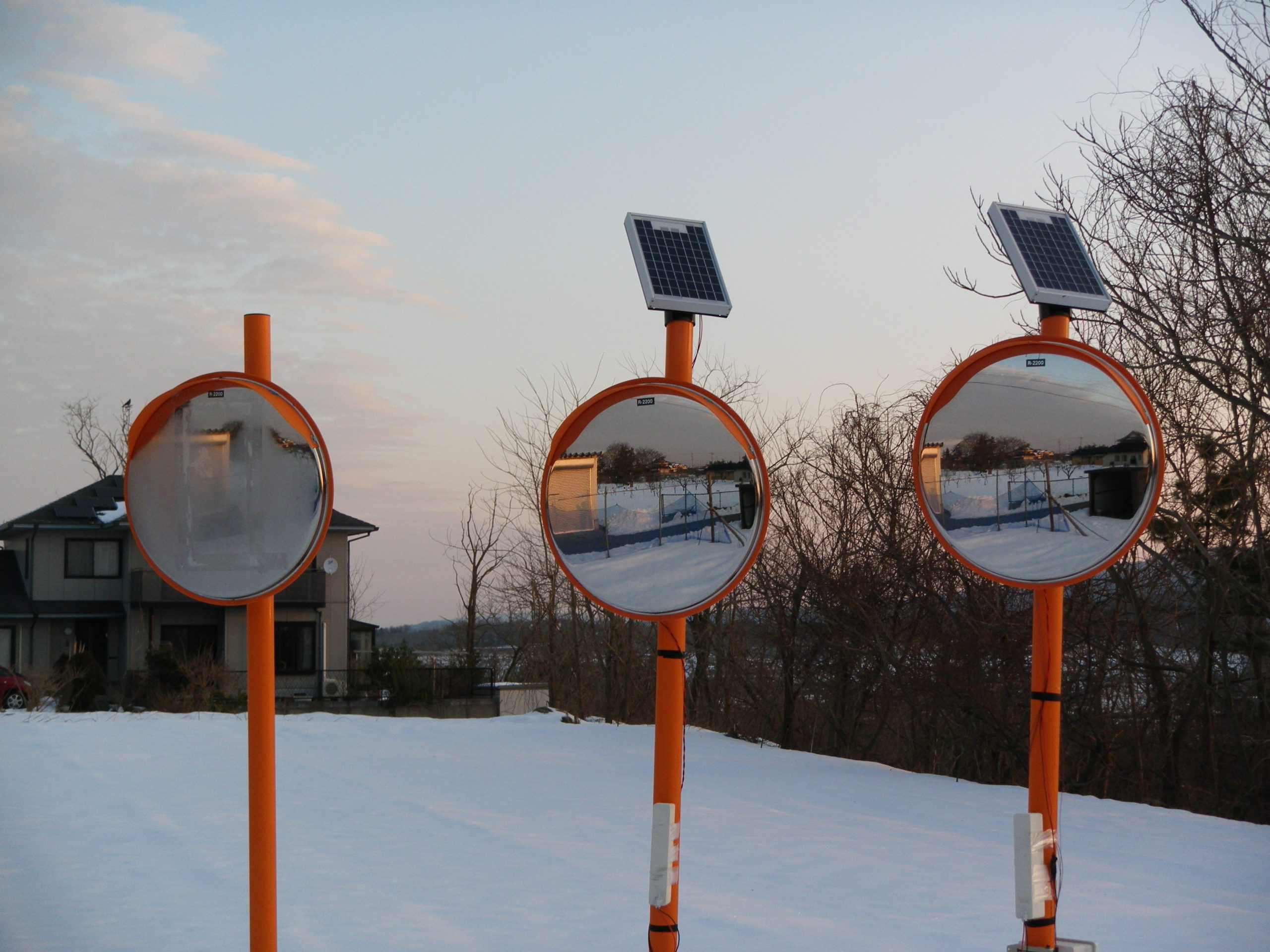
- 放射冷却の解明と「結露・霜のないカーブミラー」開発への道
- The Path to Developing a Fog-Free and Frost-Free Curve Mirror Through the Study of Radiative Cooling
- カーブミラーが結露するメカニズム
- The Mechanism of Condensation on Curve Mirrors
- 結露・霜を防ぐ「対処療法」の主な種類と課題
- Main Types of Conventional Countermeasures for Condensation and Frost, and Their Drawbacks
- ヒーター方式(ヒーター方式の核心と「結露予知センサー」発明
- Overcoming the Challenge: Innovating the Heater System and Inventing the “Condensation Prediction Sensor”
- 開発した制御回路の成果と限界
- The Developed Control Circuit: Successes and Limitations
- 空気吸い込み方式
- The Next Solution Devised: The “Air Intake Method”
- 「空気吸い込み方式」の実験結果と新たな課題
- Experiment Results of the “Air Intake Method” and New Challenges
- 内部空気循環方式
- The Path to Maintenance-Free: The “Internal Air Circulation” Concept
- 根本的な解決の達成
- Achieving the Fundamental Solution
- 根本解決を可能にした「内部空気循環方式」の原理
- The Principle of the “Internal Air Circulation Method” That Provided the Fundamental Solution
- さらなる改良:「露点予測方式」による超低消費電力化
- Further Improvement: The “Dew Point Prediction Method” for Ultra-Low Power Consumption
- 「露点予測方式」の具体的な制御ロジック
- The Specific Control Logic of the “Dew Point Prediction Method”
- 間欠運転
- 整流板追加
放射冷却の解明と「結露・霜のないカーブミラー」開発への道
研究の背景と目的
この研究は、あるカーブミラーメーカーの営業担当者から「結露と霜が付かないカーブミラーを開発できませんか」と依頼されたことをきっかけに始まりました。
私たちは、結露や霜といった表面的な現象への対処療法ではなく、その根本原因を突き止めることを目指しました。研究対象としたのは、朝の気温を大きく下げる要因である「放射冷却」です。
放射冷却のメカニズム
一般的に、結露や霜は地表付近の現象と考えられがちですが、その本質は惑星と宇宙空間との間で行われる熱の移動にあります。
-
- 放射冷却とは: 惑星が宇宙空間へ熱を放射することによって、地表(物体)の温度が冷却される現象を指します。
- 熱の収支: 惑星は、恒星(太陽など)からの光が当たることで熱を受け取ります。一方で、恒星の影になる部分(夜間)では、惑星自身が持つ熱を宇宙空間へと放出し続けます。
- 結露・霜の発生: この熱放射によって物体の表面温度が空気の露点(水蒸気が水滴に変わる温度)よりも低くなると、大気中の水蒸気が「結露」として付着します。さらに温度が下がれば「霜」となります。
研究の成果と意義
途中、研究の中断期間もありましたが、18年にわたる研究の結果、私たちはこの放射冷却のメカニズムを深く理解し、結露・霜の発生を防ぐ根本的な解決方法を見出すことができました。
この「放射冷却」という現象は、地球特有のものではありません。恒星の周りを回り、大気と液体(水など)が存在する惑星であれば、どこでも起こりうる普遍的な物理現象です。
今回の研究は、この宇宙規模の熱移動メカニズムを解明することで、身近なカーブミラーの問題を解決する糸口を発見したものと言えます。
The Path to Developing a Fog-Free and Frost-Free Curve Mirror Through the Study of Radiative Cooling
Research Background and Objective
This research began when a sales representative from a curve mirror manufacturer approached us with a request: “Could you develop a curve mirror that doesn’t fog up or accumulate frost?”
Our goal was not to find a mere “quick fix” for the superficial phenomena of condensation and frost. Instead, we aimed to identify a fundamental solution by thoroughly understanding the root cause: radiative cooling, the phenomenon responsible for significant drops in temperature during the morning hours.
The Mechanism of Radiative Cooling
While condensation and frost are often considered localized, near-surface phenomena, their true origin lies in the transfer of heat between a planet and outer space.
- What is Radiative Cooling?: It is the process by which an object (or the planet’s surface) cools down by radiating heat into space.
- The Heat Budget: A planet receives heat from its star (like our Sun). Conversely, in areas shielded from the star’s light (at night), the planet continuously radiates its own heat back into deep space.
- Formation of Condensation and Frost: Through this heat radiation, the surface temperature of an object can drop below the air’s dew point (the temperature at which water vapor turns into liquid). This causes atmospheric moisture to settle on the surface as “condensation.” If the temperature drops further, it becomes “frost.”
Research Results and Significance
Despite an interruption that paused our work, we successfully identified a fundamental solution to prevent condensation and frost after 18 years of research, based on a deep understanding of the radiative cooling mechanism.
This phenomenon of “radiative cooling” is not unique to Earth. It is a universal physical phenomenon that can occur on any planet orbiting a star, provided it has an atmosphere and a liquid (such as water).
In essence, this research has discovered a solution to the familiar problem of frosted mirrors by first elucidating the mechanics of heat transfer on a cosmic scale.
全体像を理解するための説明動画です。
カーブミラーが結露するメカニズム
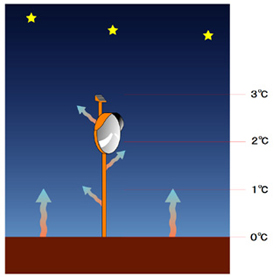
カーブミラーが結露する主な原因は「放射冷却」によって、ミラーの表面が周囲の空気よりも先に、かつ急速に冷やされるためです。
そのプロセスは、以下のステップで説明できます。
ステップ1:ミラー表面の冷却(放射冷却)
- 夜間になると、カーブミラーの表面は、宇宙空間に向けて遠赤外線(熱)を放射し始めます。これを放射冷却と呼びます。
- 熱を一方的に放出するため、ミラーの表面温度は急速に低下していきます。
ステップ2:空気の状態変化(飽和)
- ミラーの表面温度が急速に下がる一方、周囲の空気の温度は、それほど急速には低下しません。
- しかし、地面やミラーの冷却に引っぱられる形で、空気の温度も徐々に低下していきます。
- 空気は、温度が下がるほど、気体のまま保持できる水蒸気の量(飽和水蒸気量)が少なくなります。その結果、相対湿度が上昇し、やがて100%(飽和状態=空気中の水分が気体でいられない状態)に近づきます。
ステップ3:結露の発生(露点)
- この「湿度が飽和状態に近づいた空気」の中に、放射冷却によって「空気の温度よりも冷たくなったミラー」が存在する状況が生まれます。
- ミラーの表面温度が、その空気の「露点」(水蒸気が気体から液体に変わる温度)を下回ると、ミラーに触れた空気中の水蒸気が冷やされ、水滴となって表面に付着します。
これが、ミラーが結露する理由です。
要約すると、「ミラーが放射冷却で先に冷え、そこに飽和状態の空気が触れることで、ミラー表面が空気の露点を下回り結露する」ということです。
The Mechanism of Condensation on Curve Mirrors
The primary cause of condensation on curve mirrors is radiative cooling, which causes the mirror’s surface to cool more rapidly and ahead of the surrounding air.
This process can be explained in the following steps:
Step 1: Cooling of the Mirror Surface (Radiative Cooling)
- At night, the surface of the curve mirror begins to radiate far-infrared rays (heat) toward outer space. This is called radiative cooling.
- Because the mirror is unilaterally releasing heat, its surface temperature drops rapidly.
Step 2: Change in the Air’s State (Saturation)
- While the mirror’s surface temperature falls quickly, the temperature of the surrounding air does not decrease as rapidly.
- However, influenced by the cooling of the ground and the mirror, the air temperature does gradually decrease.
- As the air temperature drops, the amount of water vapor it can hold as a gas (saturated vapor pressure) decreases. As a result, the relative humidity rises, eventually approaching 100% (a saturated state, where the moisture can no longer remain a gas).
Step 3: Formation of Condensation (Reaching the Dew Point)
- This creates a situation where a “mirror that is colder than the air” (due to radiative cooling) exists within this “air that is approaching saturation.”
- When the mirror’s surface temperature falls below the air’s “dew point” (the temperature at which water vapor turns from a gas to a liquid), the water vapor in the air that touches the mirror is cooled and adheres to the surface, forming water droplets.
This is the reason why mirrors develop condensation.
In summary: The mirror cools down first due to radiative cooling. When saturated air comes into contact with this cold surface, the mirror’s temperature drops below the air’s dew point, causing condensation to form.
結露・霜を防ぐ「対処療法」の主な種類と課題
結露や霜によるカーブミラーの視界不良を防ぐため、従来、いくつかの「対処療法」が考案されてきました。主な3つの方法と、それぞれが抱える課題について解説します。
蓄熱材を入れる方法
- 原理: 日中の熱を蓄熱材に蓄え、夜間の放射冷却によるミラーの急激な温度低下を緩和することを狙った方法です。
- 課題: 天候や気温の変動(例えば、昼夜の気温が逆転するような特殊な気象条件)によっては、蓄えた熱が逆に作用し、蓄熱材入りのミラーだけが結露してしまうといった、意図しない結果を招くケースがあります。
ヒーターで加熱する方法
- 原理: ミラーの内部または裏側にヒーターを設置し、物理的に加熱することで、ミラーの表面温度を強制的に露点(結露する温度)以上に保ち、結露や霜の発生を防ぎます。
- 課題: 最も確実な方法の一つですが、商用電源を引く必要があります。そのため、設置場所が電源の有無に左右されたり、電源工事や継続的な電気代といったコストが大きな負担となります。
光触媒(親水性コーティング)を塗る方法
- 原理: ミラー表面に光触媒などを塗布し、「超親水性(水に非常になじみやすい性質)」を持たせます。これにより、結露が発生しても水滴にならず、表面に薄い水の「膜」が広がるため、視界を確保できるとされています。
- 課題: この方法は、結露(液体の水)に対しては一定の効果を発揮します。しかし、気温がさらに下がり「霜」(固体の氷)が発生すると、水の膜にならず表面が白く凍りついてしまい、結果としてミラーの視認性を失うことになります。
Main Types of Conventional Countermeasures for Condensation and Frost, and Their Drawbacks
To prevent poor visibility in curve mirrors caused by condensation and frost, several conventional “countermeasures” have been devised. This section explains the three main methods and the challenges associated with each.
Using Heat-Storing Materials
- Principle: This method aims to mitigate the rapid drop in the mirror’s temperature during nighttime radiative cooling by storing heat absorbed during the day in a special material.
- Drawback: Depending on weather and temperature fluctuations (for example, in rare conditions where night temperatures are higher than day temperatures), the stored heat can have an adverse effect. This can lead to the unintended result where only the mirrors equipped with heat-storage materials develop condensation.
Heating with an Integrated Heater
- Principle: A heater is installed inside or on the back of the mirror. By physically heating the surface, it is forcibly kept above the dew point (the temperature at which condensation forms), thus preventing both condensation and frost.
- Drawback: While this is one of the most reliable methods, it requires access to a commercial power supply. Consequently, installation locations are limited by power availability, and the costs of electrical work and ongoing electricity consumption pose a significant burden.
Applying a Photocatalyst (Hydrophilic Coating)
- Principle: A photocatalyst or similar substance is applied to the mirror’s surface to give it “super-hydrophilic” properties (meaning it attracts water). This is intended to ensure that even if condensation occurs, it does not form view-obstructing droplets but instead spreads into a thin “film” of water, thereby maintaining visibility.
- Drawback: This method is effective against condensation (liquid water). However, if the temperature drops further and “frost” (solid ice) forms, the water cannot form a film and instead freezes white on the surface, resulting in a complete loss of visibility.
ヒーター方式(ヒーター方式の核心と「結露予知センサー」発明
従来のヒーター方式が抱える課題
カーブミラーの結露対策としてヒーター方式がありますが、大きな欠点を抱えています。 それは、夜間、ミラーが結露していなくても連続して通電・加熱し続けることです。
この方式は消費電力が膨大になるため、バッテリーでの運用は非現実的であり、商用電源を引く工事が必須でした。
発明の目的:「結露予知」による低消費電力ヒーター
そこで私(たち)が考案したのが、この電力消費の課題を解決する、新しい「制御タイプのヒーター方式」です。
- コンセプト: ミラーが曇ってから加熱するのでは遅いため、「結露する直前」を予知して通電を開始します。
- 制御: 結露を未然に予防し、結露の心配がなくなったら即座に通電を停止します。
この方法により、通電時間を最小限に抑え、バッテリー駆動も可能な超低消費電力化を目指しました。
開発の鍵:なぜミラーは結露するのか?
この「結露予知」を実現するには、まず「結露しやすい条件」を正確に知る必要がありました。
私たちはまず、結露しやすい材質や形状を求めて実験を行いましたが、材質による大きな差は見られませんでした。
次に、実際に町中のカーブミラーを観察して回り、「どのミラーが」「どの部分から」結露し始めているのかを徹底的に調査しました。その結果、結露の根本原因である「放射冷却」の重要な特徴が分かってきました。
放射冷却の特性と「空の温度」
観察の結果、ミラーの中でも特に「空(宇宙)」に向いている面が最も冷たく、結露が始まることが分かりました。逆に、地面を向いている面は冷えにくいのです。
この温度差の原因は、熱の放射先にあります。
- 空(宇宙): 物質がほとんど存在しないため、温度はほぼ絶対零度(摂氏-273℃)です。ミラー表面の熱は、この極低温の宇宙空間へ一方的に放射され、急速に冷却されます。
- 地面: 地面自体が熱を持っているため、ミラーへ熱を放射(輻射)します。そのため、ミラー表面は冷えにくいのです。
この仮説を裏付けるため、日中に放射温度計で空の温度を測定してみました。
- 青空: -60℃
- 白い雲: -10℃(雲=水蒸気や氷の粒が熱を持っているため)
この「-60℃」という測定値は、月面や人工衛星の日陰部分の温度に匹敵し、空気中の塵(チリ)の影響を考慮すれば、宇宙空間がいかに冷たいかを示す納得のいく結果でした。
「結露予知センサー」の完成
ミラーが結露するメカニズム(=空に向けて熱が放射され、空気の露点よりも冷える)が解明できたことで、「結露予知センサー」の開発が可能になりました。
このセンサーは、ミラーが置かれた環境下で、ミラー表面(特に最も冷えやすい空を向いた部分)がいつ露点に達するかをシミュレートし、結露する直前にヒーターを作動させる役割を果たします。
はい、承知いたしました。 先ほど編集した「ヒーター方式の革新と結露予知センサーの発明」に関する文章を英訳します。
Overcoming the Challenge: Innovating the Heater System and Inventing the “Condensation Prediction Sensor”
The Drawback of Conventional Heater Systems
While heater systems exist as a countermeasure for condensation on curve mirrors, they have a major drawback: They remain continuously powered and heating throughout the night, even when the mirror is not fogged.
This method consumes an enormous amount of power, making battery operation impractical and requiring installation of a commercial power supply.
The Goal of the Invention: A Low-Power Heater Through “Condensation Prediction”
To solve this power consumption problem, we devised a new “controlled-type heater system.”
- The Concept: It is too late to apply heat after the mirror has fogged. Therefore, this system predicts the moment just before condensation will form and activates the power at that instant.
- The Control: It prevents fogging before it occurs and immediately stops the power as soon as the risk of condensation has passed.
This method aims to minimize power-on time, making ultra-low power consumption—and even battery operation—a possibility.
The Key to Development: Why Do Mirrors Fog Up?
To make “condensation prediction” a reality, we first needed to accurately understand the “conditions under which condensation is most likely to form.”
We began by experimenting with various materials and shapes to find what was most prone to fogging, but found no significant differences based on material.
Next, we went out and observed actual curve mirrors in the field, thoroughly investigating which mirrors fogged and which parts of the mirror fogged up first. As a result, we uncovered crucial characteristics of radiative cooling—the root cause of condensation.
Characteristics of Radiative Cooling and the “Temperature of the Sky”
Our observations revealed that condensation begins on the parts of the mirror facing the sky (outer space), as these are the surfaces that become coldest. Conversely, surfaces facing the ground do not cool down as much.
The reason for this temperature difference lies in where the heat is being radiated.
- The Sky (Space): This area is largely empty of matter, meaning its temperature is near absolute zero (-273°C or -459°F). The mirror’s surface heat is radiated unilaterally into this extremely cold space, causing it to cool rapidly.
- The Ground: The ground itself holds heat and radiates it (thermal radiation) back to the mirror. Therefore, the mirror surface facing the ground is slower to cool.
To confirm this hypothesis, we measured the temperature of the sky during the day with a radiation thermometer.
- Blue Sky: -150°C (-238°F)
- White Clouds: -10°C (14°F) (Because clouds consist of water vapor and ice particles, which hold heat.)
This measurement of -150°C is comparable to the temperatures found in the shadows of the moon or on satellites, and it provided a convincing result demonstrating how cold outer space is (factoring in the effects of atmospheric dust).
Completion of the “Condensation Prediction Sensor”
By fully understanding the mechanism of condensation (that the mirror radiates heat toward the sky, cooling it below the air’s dew point), we were able to develop the “Condensation Prediction Sensor.”
This sensor simulates the conditions of the mirror, specifically when the mirror’s surface (especially the part facing the cold sky) will reach the dew point in its environment, and it activates the heater just before condensation forms.
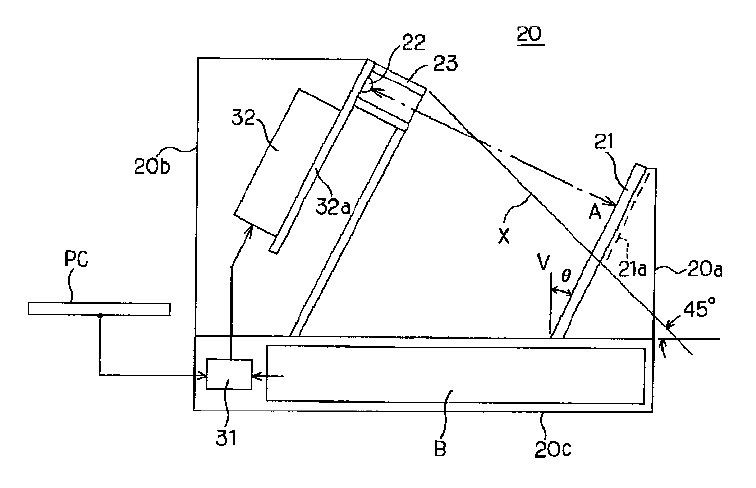
センサーの構造です。21は鏡です。21aはヒーターです。22は赤外線LEDと赤外線センサーです。鏡が斜め上を向いています。これにより垂直に立っているカーブミラーよりも少し早く結露します。センサー22が結露を関知したときヒーター21aとカーブミラーの裏面に貼ったヒーターを同時に通電し加熱します。センサーの鏡21の結露がとれたときカーブミラーのヒーターとセンサーヒーター21a両方の通電を止めます。これによりカーブミラーを結露寸前で加熱する事ができます。実験により一晩で約1分の通電が5回ありました。気温が急激に下がるとき結露するのでそのような気温変化が一晩で5回あったということだと思います。
It is the structure of the sensor. 21 is a mirror. 21a is a heater. 22 is infrared LED and infrared sensor. The mirror is facing diagonally upward. This creates dew condensation a little earlier than a curved mirror standing vertically. When the sensor 22 is concerned about dew condensation, heat the heater 21 a and the heater attached to the back of the curved mirror at the same time to heat it. When dew condensation of the mirror 21 of the sensor is taken off Stop the energization of both the curved mirror heater and the sensor heater 21 a. This allows you to heat the curve mirror just before dew condensation. Experiment showed that there was 5 energization for about 1 minute overnight. As the temperature drops sharply, because the dew condensation, I think that such temperature change was 5 times overnight.
(Translated by Google)
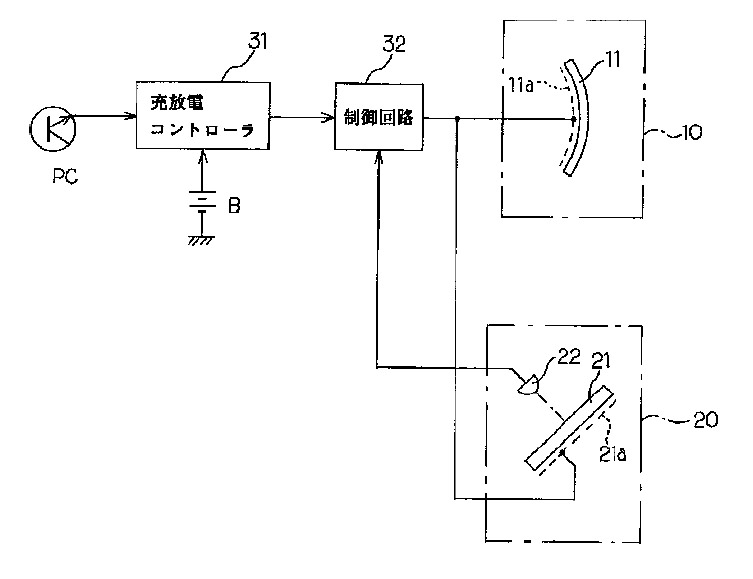
開発した制御回路の成果と限界
(ブロック図に示されている)この制御回路は、実際に動作試験を行った結果、狙い通り結露を防ぐことに成功しました。
成果と評価
この方式の最大の利点は、消費電力が非常に少なく、実用レベルに達していたことです。従来のヒーター方式が抱える電源やコストの問題を解決できる可能性がありました。
限界と製品化の断念
しかし、このセンサー制御方式も、根本原因を解決したわけではない「対処療法」の一つです。そして、対処療法にはしばしば別の問題が伴います。
この回路が抱える致命的な問題点は、「(結露予知)センサーが汚れると、正常に動作しなくなる」という点でした。
屋外で長期間、センサーの精度を維持することは困難であり、この信頼性の問題が解決できない限り、安定した製品とは言えません。そのため、私たちはこの段階での製品化を断念しました。
The Developed Control Circuit: Successes and Limitations
(As shown in the block diagram,) this control circuit was tested, and it successfully prevented condensation as intended.
Successes and Evaluation
The greatest advantage of this system was its extremely low power consumption, which reached a practical level. It had the potential to solve the power supply and cost issues associated with conventional heater systems.
Limitations and the Decision to Halt Commercialization
However, this sensor-controlled method was still just a “countermeasure” (a symptomatic treatment), not a fundamental solution. Such countermeasures often come with their own set’t of problems.
The critical flaw in this circuit was that if the (condensation prediction) sensor became dirty, it would fail to operate correctly.
It is difficult to maintain the sensor’s accuracy outdoors over long periods. Because this reliability issue could not be resolved, it could not be considered a stable product. Therefore, we abandoned commercialization at this stage.
空気吸い込み方式
光学センサー方式の課題(汚れによる誤動作)を認識し、次に私たちが考案したのが、ファンで空気を取り込む「空気吸い込み方式」です。
原理:放射冷却の「時間差」を利用
この方式は、放射冷却による温度低下の「時間差」を利用します。
- 夜間、放射冷却によってミラーの表面は急速に冷え始めます。
- しかし、ミラーよりも上空にある空気は、ミラー表面ほど急速には冷えません(温度低下が遅れます)。
- そこで、この「まだ暖かい上空の空気」をファンで強制的にミラーの内部(裏側)に吸い込み、送り込みます。
目的:結露の防止
ミラー内部に取り込まれた暖かい空気が、鏡面を裏側から暖めます。 これにより、ミラーの表面温度が、結露が発生する「露点」(または周囲の気温)を下回らないように維持し、結露を未然に防ぎます。
具体的な動作タイミング
結露の危険性が高まる(=相対湿度が100%に近づき始める)のは、放射冷却が本格化する日没付近です。 そのため、このタイミングでファンを稼働させ、ミラー内部への空気の送り込みを開始します。
今後の課題
この方式を実用化するためには、以下の検証が必要です。
- 最適なバランスの計算: その時々の「放射冷却の強さ(ミラーが冷える速度)」に対して、どれくらいの「空気の量(ファンの強さ)」を送れば結露を確実に防げるのか、その最適なバランスを見極める必要があります。
- コスト計算と実証: このバランス(必要なファンの性能や消費電力)と、製造コストを考慮した上で、最低1年間の実証試験を行い、実用性を検証する必要があります。
The Next Solution Devised: The “Air Intake Method”
Recognizing the drawback of the sensor method (malfunctioning when dirty), the next solution we devised was the “Air Intake Method,” which uses a fan.
The Principle: Utilizing the “Time Lag” of Radiative Cooling
This method takes advantage of the “time lag” in temperature drops caused by radiative cooling.
- At night, the mirror’s surface begins to cool rapidly due to radiative cooling.
- However, the air located above the mirror does not cool down as quickly as the mirror surface (its temperature drop is delayed).
- Therefore, this “still warm upper air” is forcibly drawn by a fan into the interior (the backside) of the mirror.
The Objective: Preventing Condensation
The warm air drawn into the mirror’s interior heats the mirror surface from behind. This action maintains the mirror’s surface temperature, preventing it from dropping below the “dew point” (or the surrounding ambient temperature) at which condensation would form.
Specific Operational Timing
The risk of condensation becomes highest (as relative humidity approaches 100%) around sunset, which is when radiative cooling intensifies. Therefore, the fan is activated at this time to begin feeding air into the mirror’s interior.
Future Challenges
To make this method practical, the following points must be verified:
- Calculating the Optimal Balance: We must determine the optimal balance between the “intensity of radiative cooling” (the rate at which the mirror cools) and the “volume of air” (fan strength) required to reliably prevent condensation under various conditions.
- Cost Calculation and Field Testing: Considering this balance (which dictates the necessary fan performance and power consumption) alongside manufacturing costs, a minimum one-year field test is required to verify the system’s practicality.
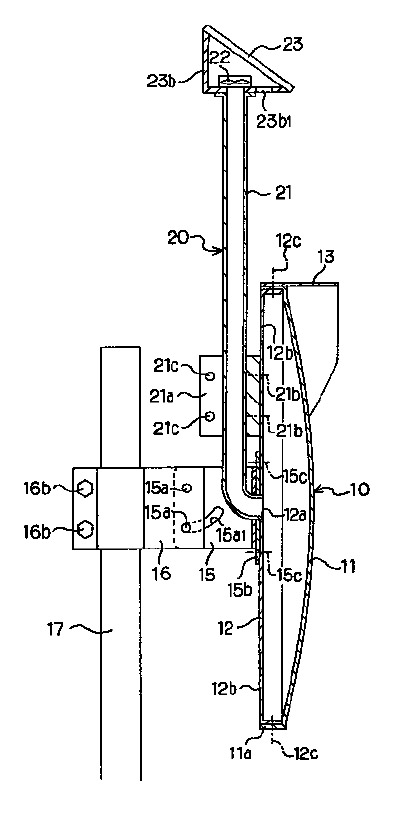
原理図です。
23:電源用バッテリーを充電する太陽電池
22:空気をミラー内部へ送り込むファン
It is a principle diagram.
23: Solar battery to charge power supply battery
22: Fan that feeds air inside the mirror
(Translated by Google)
「空気吸い込み方式」の実験結果と新たな課題
実験結果:結露予防の成功
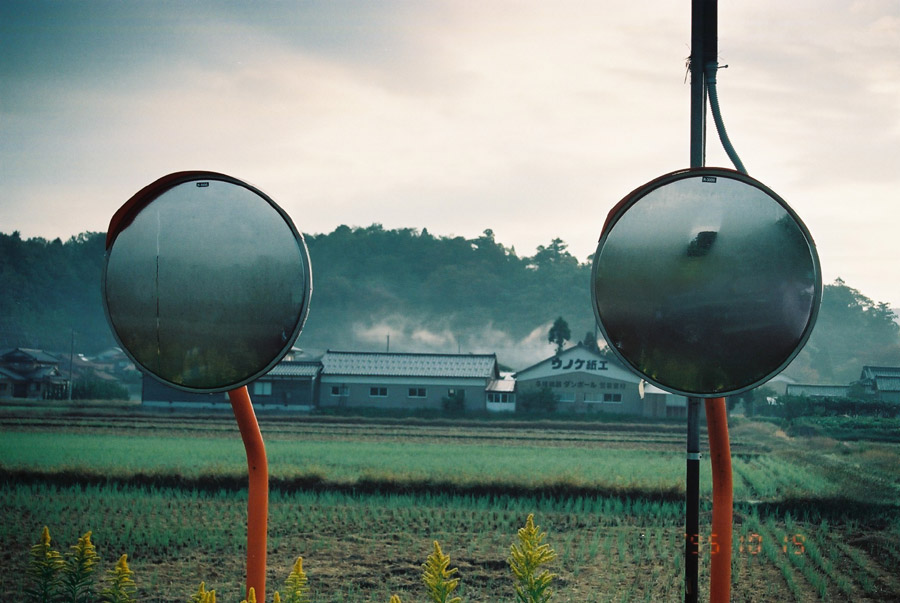
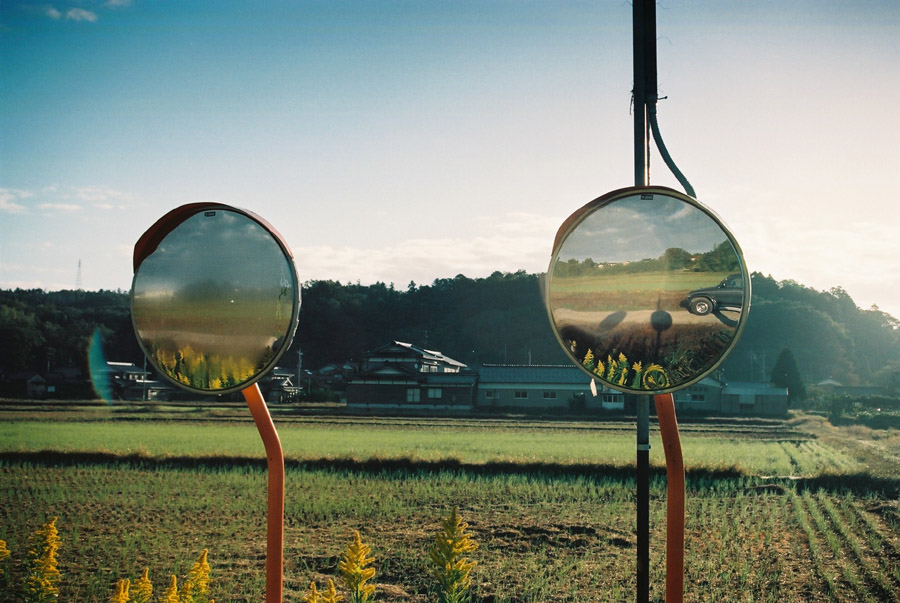
実験写真が、その結果を示しています。(当時はまだフィルムカメラを使っていました)
- 失敗例(上の写真): 当初、ミラー裏面に吸い込みホースを近づけすぎたため、ホース周辺の一部しか結露を予防できませんでした。
- 成功例(下の写真): その後、パイプの配置を工夫してミラー裏面全体に空気が行き渡るようにした結果、ミラー全体の結露を予防することに成功しました。
実験から得られた結論
この実験により、「夜間、ミラーより1m上にある(まだ冷えていない)空気を吸い込む」ことで、カーブミラーの結露は予防可能であると実証できました。
パフォーマンス評価(消費電力)
消費電力を測定したところ、0.1A × 12時間 = 1.2Ah となりました。 これは、先に開発した制御ヒータータイプとほぼ同じ消費電力量でした。このことから、「結露を防ぐ」という同じ目的を達成するために必要なエネルギー量は、方式が異なっても近似するのではないか、という推察が得られました。
新たな課題と製品化の断念
しかし、この「空気吸い込み方式」にも実用化に向けた大きな欠点があることが判明しました。
- 課題: 空気の吸い込み口には必ず穴が開いており、長期間使用するうちに虫や枯れ葉などが詰まる可能性が極めて高い。
- 判断: カーブミラーには「最低10年間メンテナンスフリー」という高い耐久性が求められます。この方式は定期的な清掃が必要となり、要件を満たせないため、製品化を断念しました。
Experiment Results of the “Air Intake Method” and New Challenges
Experiment Results: Successful Condensation Prevention
The experiment photos (taken with an old film camera) show the results.
- Failed Attempt (Top Photo): Initially, the intake hose was placed too close to the back of the mirror, which only prevented condensation in the small area surrounding the hose.
- Successful Attempt (Bottom Photo): Later, by improving the pipe layout to ensure air was distributed across the entire back surface, we successfully prevented condensation on the whole mirror.
Conclusion from the Experiment
This experiment demonstrated that condensation on curve mirrors can be prevented by drawing in air from 1 meter above the mirror (where the air is still warmer) during the night.
Performance Evaluation (Power Consumption)
The power consumption was measured at 0.1A × 12 hours = 1.2Ah. This was approximately the same energy consumption as the controlled-heater type developed earlier. This led to the speculation that the amount of energy required to achieve the same goal (preventing condensation) might be similar, even if the method is different.
New Challenges and Abandonment of Commercialization
However, it became clear that this “Air Intake Method” also had a major drawback for practical use.
- The Challenge: The air intake port necessarily has an opening. Over long-term use, it is highly likely to become clogged with insects, dry leaves, and other debris.
- The Decision: Curve mirrors are required to be highly durable and “maintenance-free for a minimum of 10 years.” This method would require regular cleaning and could not meet that requirement. Therefore, we abandoned its commercialization.
内部空気循環方式
メンテナンスフリーへの道:「内部空気循環方式」という着想
新たな着想
(吸い込み方式の断念から)数年後、私はふと新たな可能性に気づきました。 「もしかしたら、虫や枯れ葉が詰まる原因となる“吸い込み口”自体を無くしても、ミラーの冷却を防げるのではないか?」
新方式の原理(仮説)
このアイデアの原理は、「空気吸い込み方式」と同様に温度低下の「時間差」を利用しますが、今度はミラー内部の空気に着目したものです。
- 夜になり外気温が下がっていくとき、ミラーの鏡面は放射冷却によって急速に冷えようとします。
- しかし、ミラーの筐体内部に密閉されている空気は、鏡面や外気に比べて冷えるのが遅いはずです。
- そこで、この「まだ温度が高い内部の空気」を(例えば小型ファンなどで)鏡面の裏側で強制的に循環させ、ミラー(鏡面)と内部の空気の温度を「馴染ませる」のです。
この熱交換により、ミラー表面だけが極端に冷えるのを防ぎ、その温度を外気温とほぼ同じレベルに保つことができるのではないか、と推論しました。
実験結果
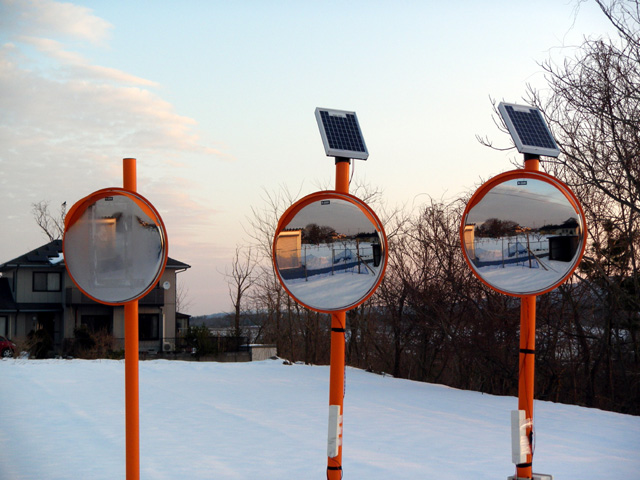
この仮説に基づき実験を行ったところ、狙い通りミラーの温度低下が緩和されました。 その結果、下の写真が示すように、結露だけでなく霜の発生も予防できることが確認できたのです。
The Path to Maintenance-Free: The “Internal Air Circulation” Concept
A New Insight
Several years (after abandoning the air intake method), a new possibility suddenly occurred to me. “Perhaps it’s possible to prevent the mirror from cooling down even without an ‘intake port’“—the very component that causes clogging from insects and leaves.”
The Principle of the New Method (Hypothesis)
The principle behind this idea, like the air intake method, utilizes the “time lag” in temperature drop, but this time, it focuses on the air inside the mirror.
- When night falls and the outside air temperature begins to drop, the mirror’s surface tries to cool rapidly due to radiative cooling.
- However, the air sealed inside the mirror’s housing should cool down more slowly than the mirror surface or the outside air.
- Therefore, if this “still warm internal air” is forcibly circulated (perhaps with a small fan) against the back of the mirror surface, it will “equalize” the temperature between the mirror (surface) and the internal air.
I reasoned that this heat exchange could prevent the mirror surface alone from becoming extremely cold, allowing its temperature to be maintained at nearly the same level as the ambient air temperature.
Experiment Results
We conducted an experiment based on this hypothesis, and as intended, the rapid temperature drop of the mirror was mitigated. As a result, as the photo below shows, we confirmed that this method could prevent not only condensation but also the formation of frost.
根本的な解決の達成
この「内部空気循環方式」は、ミラー表面が放射冷却によって極端に冷えること自体を防ぎます。
その結果、ミラー表面の温度は常に周囲の空気の温度に近い状態に保たれ、水分が凝縮して付着する「露点」を下回らなくなります。
これにより、気温が氷点下になる厳しい環境下でも、結露も霜も発生しません。
これは、センサーの汚れや吸い込み口の詰まりといった「対処療法」が抱える問題点を克服した、真の「根本的な解決」と言えます。
Achieving the Fundamental Solution
This “Internal Air Circulation Method” prevents the mirror’s surface itself from becoming extremely cold due to radiative cooling.
As a result, the mirror’s surface temperature is consistently kept close to the temperature of the surrounding air, ensuring it no longer drops below the “dew point” or “freezing point” where moisture condenses and adheres.
This means that even in harsh environments where the temperature falls below freezing, neither condensation nor frost forms.
This represents a true “fundamental solution,” as it overcomes the drawbacks inherent in “countermeasures,” such as sensor contamination or intake clogging.
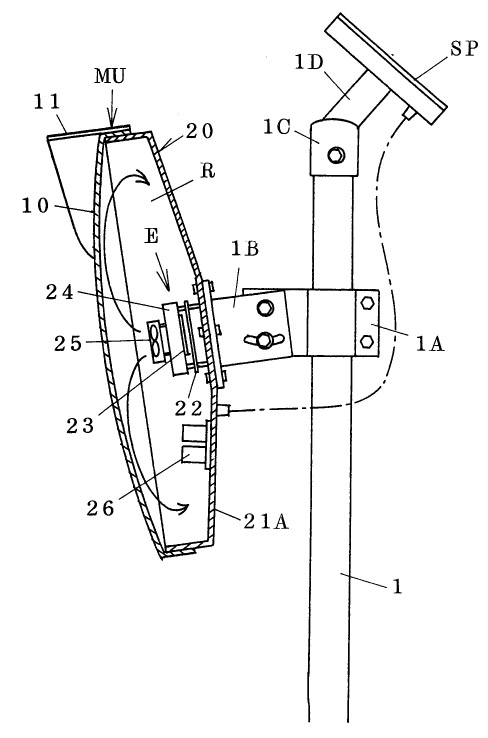
根本解決を可能にした「内部空気循環方式」の原理
この方式は、太陽電池を利用したシンプルな仕組みで、ミラー表面が放射冷却によって露点以下に冷えることを防ぎます。
動作プロセス
- エネルギー確保(日中): 日中、太陽電池が発電し、その電力を蓄電池に充電します。
- 熱交換の実行(夜間): 日没から日の出までの間、蓄電池の電力を利用して、ミラー内部に設置されたファンを稼働させます。
- 内部空気の撹拌(かくはん): ファンがミラー筐体内部の空気を強制的に撹拌します。これにより、放射冷却で急速に冷えようとする鏡面(表面)と、まだ温度が下がっていない内部の空気との間で、効率的に熱が交換されます。
達成された結果
この動作により、ミラー表面の温度だけが低下することを防ぎ、表面温度を常に周囲の気温とほぼ同じ状態に保つことができました。これにより、結露や霜の発生を根本的に防ぎます。
開発の所感
文章で説明すればわずか数行の仕組みですが、この単純明快な原理にたどり着くまでには、18年という長い歳月を要しました。
この過程で、私たちは「放射冷却」という現象について、徹底的に理解を深められたと自負しております。関連する特許を調査する限りにおいても、私たちが到達した放射冷却に関する知識と理解度は、非常に高いレベルで完成したものと確信しています。
The Principle of the “Internal Air Circulation Method” That Provided the Fundamental Solution
This method uses a simple system powered by solar energy to prevent the mirror’s surface from becoming extremely cold due to radiative cooling.
The Operational Process
- Energy Storage (Daytime): During the day, the solar panel generates electricity, which is used to charge the rechargeable battery.
- Heat Exchange (Nighttime): From sunset to sunrise, the system uses the battery’s power to operate a fan installed inside the mirror.
- Internal Air Agitation: The fan forcibly agitates (circulates) the air sealed inside the mirror’s housing. This efficiently transfers heat between the mirror’s surface (which is trying to cool rapidly via radiative cooling) and the internal air (which has not yet cooled down).
The Result Achieved
This operation prevents the mirror’s surface temperature from dropping excessively. As a result, we successfully maintained the surface temperature at nearly the same level as the ambient air temperature, fundamentally preventing the formation of condensation and frost.
Reflections on the Development
Although it can be described in just a few lines of text, it took 18 years to arrive at this simple, clear principle.
Through this process, I am proud to say that we gained a thorough understanding of the phenomenon of radiative cooling. Based on searches of existing patents, I am confident that the knowledge and understanding of radiative cooling we achieved have been perfected to an exceptionally high level.
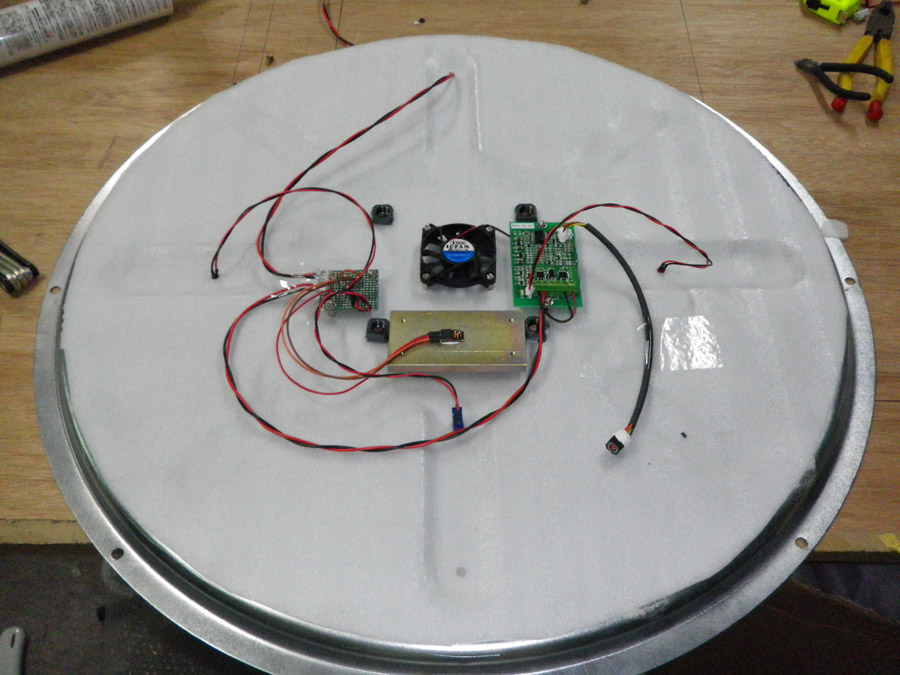
これが実験用ミラーの内部です。制御はソフトウェアで決めています。
This is the inside of the experimental mirror. Control is decided by software.
さらなる改良:「露点予測方式」による超低消費電力化
「内部空気循環方式」は根本的な解決策となりましたが、これを量産化する際のコストダウン(具体的には太陽電池や蓄電池の小型化)を目指し、さらなる改良発明を行いました。
改良の目的:消費電力の最小化
改良の目的は、消費電力をさらに小さくすることです。 従来の「内部空気循環方式」は、日没から日の出までファンを常時稼働させていました。もし、このファンの稼働時間を必要最小限にできれば、システム全体の消費電力を大幅に削減できます。
新たな着想:「必要なときだけ」動かす
そこで考案したのが、「結露や霜が発生しそうになる、本当に必要なときだけ」ファンに電源を供給する方式です。
この方式は、ミラー表面が結露する温度(露点)に達するタイミングを予測するため、「露点予測方式」と名付けました。
Further Improvement: The “Dew Point Prediction Method” for Ultra-Low Power Consumption
While the “Internal Air Circulation Method” was a fundamental solution, we made further improvements aimed at cost reduction for mass production (specifically, by downsizing the solar panel and battery).
Goal of the Improvement: Minimizing Power Consumption
The goal of the improvement was to further reduce power consumption. The conventional “Internal Air Circulation Method” ran the fan continuously from sunset to sunrise. If this fan operation time could be limited to the bare minimum, the system’s overall power consumption could be drastically reduced.
The New Concept: Operating “Only When Necessary”
This led to the idea of a system that supplies power to the fan “only when condensation or frost is actually about to form.”
We named this the “Dew Point Prediction Method” because it predicts the moment the mirror’s surface is about to reach the condensation temperature (the dew point).
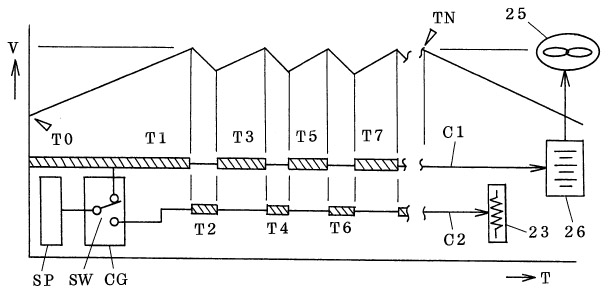
「露点予測方式」の具体的な制御ロジック
制御の基本方針
この方式の目的は、ファンを「必要なときだけ」動作させることです。 具体的には、ミラーの表面温度を常に測定しておき、その温度が結露の発生する温度(露点)を下回る直前にファンを動作させ、結露を予防します。
安全が確認されればファンを停止し、また温度が下がり始めたら動作させる、という「断続的な電源供給(上の図のような動作)」を実現します。
制御ロジックの壁:「湿度測定」の課題
しかし、この「露点の予測」には大きな壁がありました。 通常、露点を正確に計算するには「気温」と「湿度」の2つのデータが必要です。気温の測定は簡単ですが、屋外環境で長期間にわたり正確な湿度を測定し続けることは、センサーのコストや耐久性(汚れ・劣化)の面で非常に面倒であり、現実的ではありません。
課題の突破口:結露発生時の「特殊条件」への着目
そこで発想を転換し、私たちが対象としている結露が「特殊な条件下」でのみ発生することに着目しました。
その条件とは、「放射冷却によってミラーや地面が冷え、それに伴い急激に気温が低下し、相対湿度が100%に限りなく近づく」という状況です。
新ロジックの構築:湿度を測らずに露点を予測する
この特殊条件下では、相対湿度は常に「100%に近い(=結露しやすい飽和状態)」と見なすことができます。
そうであれば、わざわざ面倒な「湿度」を直接測定しなくても、
- ミラー表面の温度(放射冷却で先行して冷える)
- 外気温(ミラーより遅れて冷える)
この2つの温度を測定・比較し続けるだけで、「ミラー表面が露点にどれだけ近づいているか」を間接的に予測し、ファンの動作を精密に制御できるのではないか、と考えました。
The Specific Control Logic of the “Dew Point Prediction Method”
The Basic Control Policy
The goal of this method is to operate the fan “only when necessary.” Specifically, this is achieved by continuously measuring the mirror’s surface temperature and activating the fan just before that temperature drops below the dew point (the temperature at which condensation forms) to prevent fogging.
This realizes an “intermittent power supply” (as shown in the diagram above), where the fan stops once the risk is gone and restarts only when the temperature begins to drop dangerously low again.
The Control Logic Hurdle: The Challenge of “Humidity Measurement”
However, there was a significant obstacle to this “dew point prediction.” Normally, accurately calculating the dew point requires two data points: “air temperature” and “humidity.” While measuring temperature is easy, continuously measuring humidity accurately in an outdoor environment over many years is extremely problematic and impractical, due to sensor cost and durability issues (dirt, degradation).
The Breakthrough: Focusing on the “Special Conditions” of Condensation
We therefore shifted our thinking and focused on the fact that the condensation we are targeting only occurs under “special conditions.”
Those conditions are: “A situation where radiative cooling cools the surface (the mirror), causing a rapid drop in air temperature, which in turn causes the relative humidity to rise infinitely close to 100%.”
Building the New Logic: Predicting the Dew Point Without Measuring Humidity
Under these specific conditions, the relative humidity can always be assumed to be “near 100%” (i.e., in a saturated state ready to condense).
If that is the case, we reasoned that we could accurately predict how close the mirror surface is to the dew point and precisely control the fan—without needing to measure the problematic “humidity” directly—by simply:
- Measuring the mirror surface temperature (which cools down first due to radiative cooling).
- Measuring the ambient air temperature (which cools down slower than the mirror).
And continuously comparing these two temperatures.
間欠運転
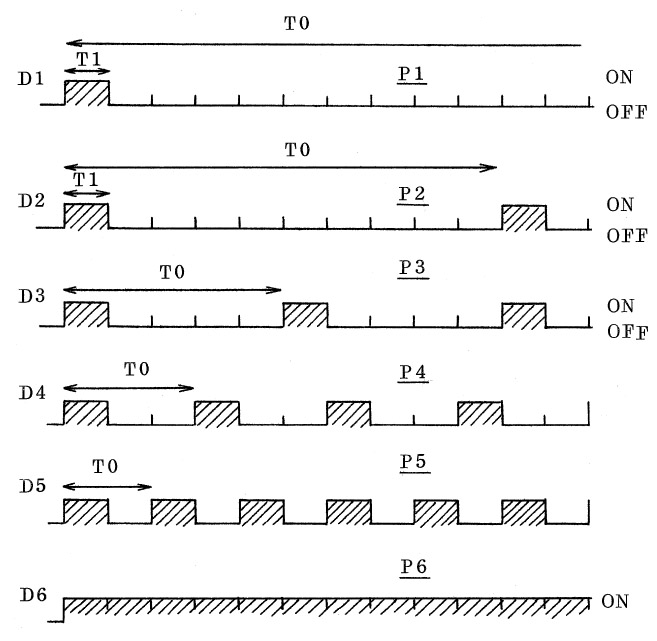
次にミラーを動作させるとき単に連続して電源を供給するのではなくONとOFFの比率を可変することにしました。
Next, when operating the mirror, we decided to change the ratio of ON and OFF rather than simply supplying power continuously.
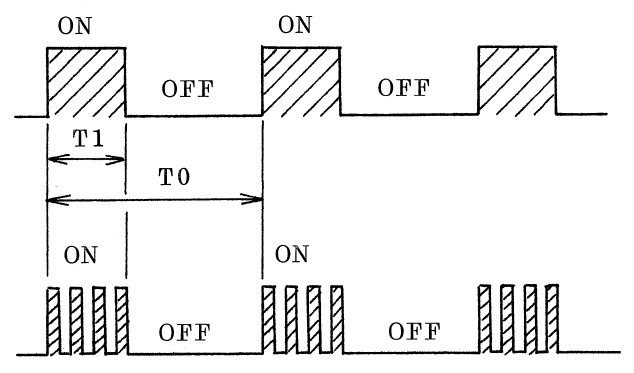
さらに節電するため、ONの時間連続して供給するのではなくONの波形の中をPWM制御しファンの回転数を落とさないように消費電力を減らす方法を考えました。
しかしデューティーを50%にすると下の写真のように完全に結露を予防する事ができませんでした。
In order to conserve power, I thought about a way to reduce the power consumption so as not to decrease the rotation speed of the fan by PWM control in the ON waveform instead of continuously supplying it for ON time.
However, when the duty was set to 50%, it was impossible to completely prevent dew condensation as shown in the picture below.
中心部分だけにしか効果がありませんでした。
そこで商品電力をこのままにして効率を上げる方法を考えました。
なかなかしぶとい性格です。
It was effective only in the central part.
So I thought about how to increase the efficiency by keeping the product electric power as it is.
I will not give it up.
整流板追加
少ない風量で流速を上げるためミラー内部に仕切り板を設ける事にしました。
ミラーと裏板の間にドーナツ型の板を設置します。
真ん中にファンを設置して周囲はミラーの直径より少し小さくして隙間を空けておきます。
ミラーから裏側へ空気を引くとドーナツ状の仕切り板の外周からミラー裏面へ空気が戻っていきます。空気が流れる断面積が約半分になるので流速が上がります。
さらに仕切り板をミラー裏面に近づけるとさらに断面積が小さくなり流速が上がります。
これによりファンの消費電力を増やさずにミラー裏面の空気の流速を上げます。流速が上がれば空気とミラーとの温度の馴染み方が濃くなり露点以上に保つ事ができると思います。
この改良を行うことで、0.5Wの消費電力で、霜と結露を予防することができると思います。
とても消費電力が少なく、外部に通じる穴も無く、ミラーに突起物も付かない構造になります。実現可能ではないでしょうか。
8. Addition of rectifier board
In order to raise the flow velocity with a small air flow rate, we decided to provide a partition plate inside the mirror.
Place a donut shaped plate between the mirror and the back plate.
Install the fan in the middle and keep the gap slightly smaller than the diameter of the mirror around the periphery.
When drawing air from the mirror to the back side, air returns from the outer periphery of the donut shaped partition plate to the back side of the mirror. The flow speed increases because the cross section through which air flows is about half.
Furthermore, bringing the partition plate closer to the back side of the mirror further reduces the cross sectional area and increases the flow velocity.
This increases the air flow velocity on the back of the mirror without increasing fan power consumption. If the flow rate goes up, I think that it is possible to keep the temperature of the air and mirror more familiar, and it can be kept above the dew point.
ここまでが私が実験した内容です。
18年という貴重な時間を無駄にしたような気がします。
しかし、放射冷却を理解したので他に応用方法が無いか考えてみました。
これまでの実験は放射冷却で冷えないようにする研究です。冷えても良いのであれば住宅の室内を冷やしてみようと思い新たな研究を開始しました。

This is what I have experimented.
I feel that I wasted valuable time of 18 years.
この研究中に出願した特許
特許4382870
特許4571706
特開平08-209637
特開2002-105915
特開2010-255197
特開2011-127354
特開2011-231573
The patent filed during this research
Patent 4382870
Patent 4571706
Japanese Patent Application Laid-open No. 08-209637
JP-A-2002-105915
JP 2010-255197
JP 2011-127354
Japanese Unexamined Patent Application Publication No. 2011-231573